12 Signs Your HR Doesn't Understand Labor Law — and When to Bring In an HR Consultant

Employers think they're saving money by paying less for HR. In reality, they're shifting the cost from payroll to legal fees, at a significant premium, and shifting the workload back onto executives. Underpaying HR doesn't reduce risk; it guarantees it.
Labor law compliance isn't something an entry-level HR generalist can learn on the job. The FLSA, ADA, FMLA, Title VII, and a growing patchwork of state laws all intersect with one another, and internal compliance mistakes rarely surface until a complaint, an agency investigation, or a demand letter arrives.
Below are 12 signs your HR function doesn't understand labor law, the compliance failures that follow, and when it makes sense to bring in an experienced HR consultant or outsourced CHRO.
Key takeaways
The most expensive HR compliance failures involve wage-and-hour errors, ADA and FMLA process breakdowns, retaliation, and mishandled harassment complaints.
Most of these failures come from missing systems and untrained managers, not bad intent, and they surface only after a complaint or lawsuit.
Wage-and-hour claims are especially costly because employers can owe the plaintiff's attorney's fees, and most EPLI policies exclude them.
Signs you need outside help include crossing 15 or 50 employees, hiring remote workers in new states, or receiving a DOL inquiry, EEOC charge, or demand letter.
An HR consultant, outsourced HR director, or fractional CHRO can provide senior labor law expertise without a full-time executive salary.
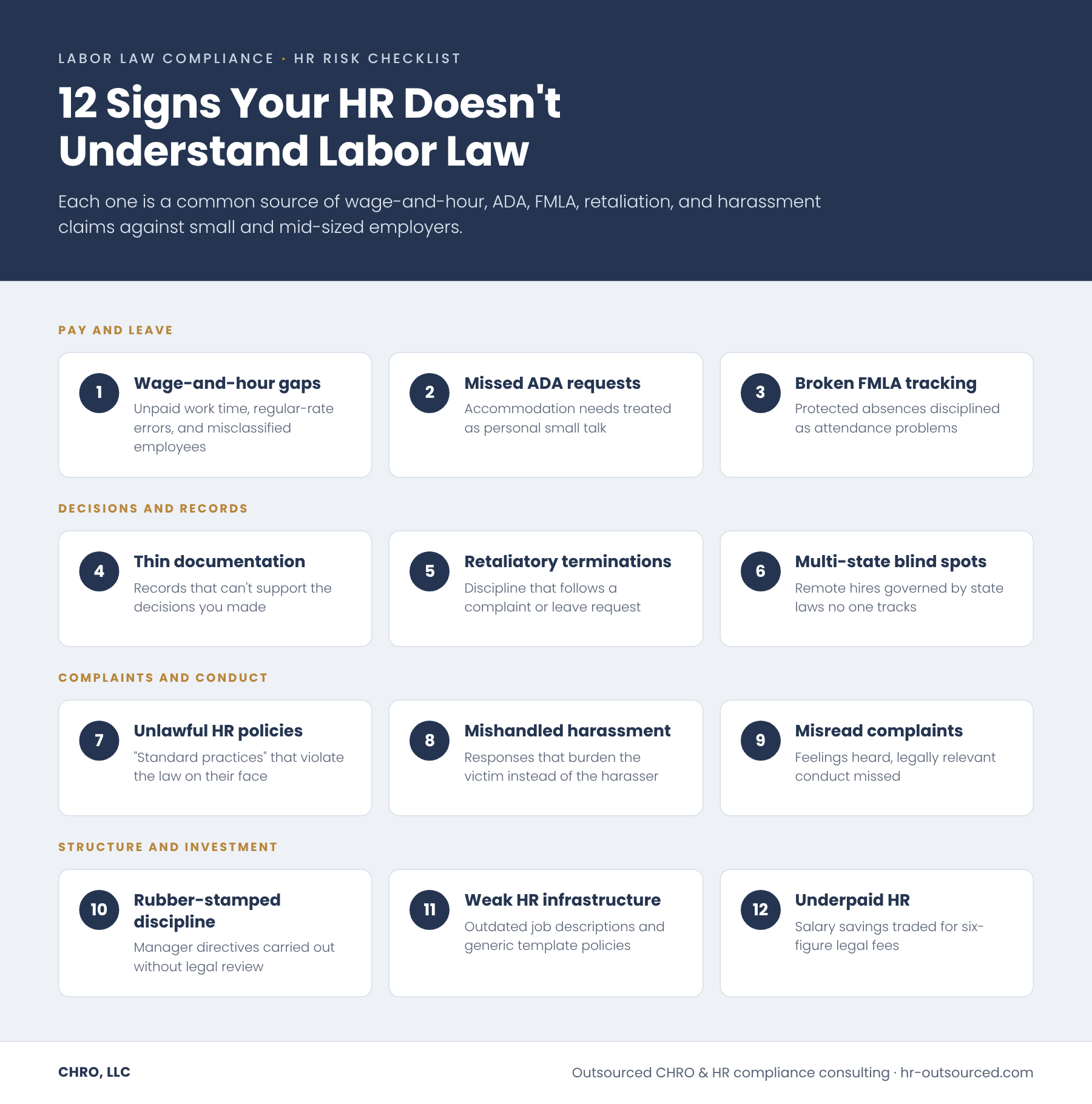
1. Wage-and-Hour Compliance Gaps: Regular Rate Errors, Misclassification, and Unpaid Work Time
The Fair Labor Standards Act has a multi-tiered footprint across your organization. FLSA compliance isn't owned by one department. It's a coordinated effort across Finance, Operations, HR, and IT, typically led by an HR leader who understands how these functions intersect. Compliance begins at the HRIS implementation stage, where system configuration determines how time, pay, and job classifications are tracked. It then carries through to every department via comprehensive, workplace-specific policies and procedures.
But when you combine inexperienced HR with frugal executives who are unversed in labor law, you're laying the groundwork for a very expensive problem down the road, one that wage-and-hour plaintiffs' attorneys love and EPLI policies rarely cover. The obvious vulnerabilities are misclassified employees and failure to pay for compensable time. But when you dig into the details, the noncompliance often shows up as:
failure to pay overtime accurately because you did not account for shift differentials, bonuses, or "volunteer time"
travel time that wasn't paid
boot-up and log-in time that starts the continuous workday
remote work performed outside scheduled hours
pre-shift and post-shift emails
"off-the-clock" tasks managers casually request or initiate
These issues often come to leadership's attention after an employee has filed a complaint with the Department of Labor, or found an attorney who now smells a class action and a sizeable legal fee award. Remember, if the plaintiff wins, you're on the hook not only for your own legal fees, but for theirs too.
2. ADA Compliance Failures: Missed Accommodation Requests and Broken Internal Processes
Employees rarely say, "I'm requesting an ADA accommodation." They mention pain, anxiety, medication changes, transportation issues, or difficulty with a schedule. Junior HR staff treat these comments as personal disclosures rather than legal triggers. They don't recognize that an employee doesn't need to use the words "ADA" or "accommodation." Once an employee connects a medical condition to a problem at work, the employer's obligation to engage in the interactive process begins.
The deeper problem is structural. Inexperienced HR hasn't built the internal training, documentation, or policy architecture needed to support ADA compliance. They leave ADA issues to managers who are just as untrained, which guarantees trouble once something comes to light.
Without experienced HR leadership, you routinely see:
confidentiality breaches when managers discuss an employee's medical condition with others
requests for far more medical information than the employer is legally entitled to
prompting disability disclosures from applicants or employees without any business justification
pejorative or dismissive remarks about disabled employees framed as "performance concerns"
blanket statements like "we need you at 100%" or "we don't do modified schedules"
managers making unilateral decisions about restrictions without HR or legal review
Several of these are ADA violations on their own, and the rest become powerful evidence in a discrimination or retaliation claim. They accumulate quietly until an employee files a complaint or is terminated shortly after disclosing a medical issue. By then, the record is full of confidentiality failures, discriminatory statements, and missed interactive-process obligations.
The ADA is one of the most complex employment laws in the country. Without experienced HR leadership, compliance becomes a series of improvised decisions made by untrained managers, creating predictable, high-value claims that are easy for plaintiffs' attorneys to prove. Even experienced HR professionals run afoul of it.
3. FMLA Compliance Failures: Eligibility Mistakes, Broken Tracking, and Manager-Driven Liability
The FMLA is unforgiving. Eligibility calculations, rolling periods, intermittent-leave tracking, certification deadlines: every step has rules, exceptions, and strict notice-timing requirements. One missed detail can become the foundation of an interference or retaliation claim months later.
Inexperienced HR personnel struggle because FMLA compliance isn't a single task; it's a system. It requires accurate hours-worked calculations, timely notices, proper certification handling, and consistent tracking of intermittent leave. Junior HR staff rarely build this infrastructure. They rely on spreadsheets, inconsistent manager reports, or whatever their HRIS "seems" to track, even though most systems require custom configuration to handle rolling periods and partial-day leave.
When HR doesn't control the process, managers end up improvising. That's where predictable violations occur: employees are disciplined for absences that should have been protected, certification deadlines are missed, intermittent leave is tracked incorrectly, and supervisors treat protected leave as "attendance problems." By the time HR realizes the mistake, the record already shows inconsistent treatment and discipline tied to protected absences.
The FMLA does not care whether the employer intended to violate the law. It cares whether the employer followed the process. Inexperienced HR can't maintain that process, and growing companies end up with avoidable interference and retaliation claims that plaintiffs' attorneys can prove with minimal effort. Learn how our FMLA compliance outsourcing builds that process for you.
4. Documentation Gaps: How Weak Records Create Strong Claims

Thin files tell the wrong story. When HR documents only the "big" issues, skips follow-ups, or allows managers to discipline inconsistently, the record becomes whatever the employee says it is. In litigation, the absence of documentation is treated as evidence, and juries fill in the gaps with assumptions that favor the employee.
The most dangerous gap is inconsistency between what the file says and what the employer later claims. A manager gives an employee three years of "meets expectations" reviews, never writes up a single issue, and then terminates for "longstanding performance problems." To a plaintiff's attorney, that's not a performance case. It's evidence of pretext.
Experienced HR builds documentation that protects employers as a habit, not a reaction. That means contemporaneous notes of coaching conversations, written warnings that cite specific conduct and expectations, records of every accommodation request and interactive-process step, and leave paperwork that shows notices went out on time. It also means honest performance reviews, because inflated reviews are often the first exhibit in a discrimination case.
5. Retaliatory Terminations: When Protected Activity Is Misread as a "Performance Problem"
Employees complain about pay accuracy, unfair discipline, "creepy" coworkers, or feeling singled out. Junior HR staff treat these disclosures as interpersonal drama instead of protected activity. When the manager later pushes for termination, HR accepts the framing, unaware they're creating a retaliation claim.
Retaliation is consistently the most frequently filed charge with the EEOC, and it's often easier to prove than the underlying complaint. An employer can win the discrimination claim and still lose on retaliation.
Protected activity is broader than most junior HR staff realize. It includes complaints about discrimination or harassment, but also complaints about unpaid wages or overtime, requests for accommodation or medical leave, safety concerns, participation in an investigation, and in many cases, discussing pay with coworkers. Once an employee engages in any of these, every later adverse action will be scrutinized for timing and motive.
Timing is the red flag courts notice first. A termination, demotion, schedule change, or sudden write-up that follows a complaint by days or weeks invites an inference of retaliation, even if the manager's concerns were real. Experienced HR checks for recent protected activity before any adverse action and makes sure the business reason is documented, consistent, and applied to others the same way.
6. Multi-State Labor Law Compliance Blind Spots: Remote Work and State-Specific Laws
Remote work has turned every employer into a multi-state employer. Pay transparency laws, paid sick leave, salary history bans, local ordinances: junior HR staff often don't know these laws exist. Compliance gaps stay invisible until an audit or complaint forces them into view.
When an employee works remotely from another state, that state's employment laws generally follow the employee. That can change the minimum wage you owe, how overtime is calculated, how much paid sick leave the employee earns, when final paychecks are due, which notices you must provide, and what your job postings must disclose about pay. Some cities and counties layer on their own requirements.
These laws change constantly, and a policy that was compliant at headquarters can be noncompliant for a single remote hire. Experienced HR tracks where every employee actually works, maintains state-specific addenda to the handbook, and reviews job postings and pay practices before hiring in a new jurisdiction. See how this plays out when multi-site employers outgrow their HR structure.
7. Unlawful HR Policies: "Standard Practices" That Violate Employment Law
Some policies feel neutral but are unlawful the moment they're applied. Policies like "we don't do transfers during probationary periods," "we don't pay for travel time," "we don't allow intermittent leave," or "you must be 100% healed to return to work" can create liability instantly.
Each of those examples conflicts with a specific legal obligation:
"No transfers during probation": under the ADA, reassignment to a vacant position can be a required accommodation, regardless of an internal waiting period.
"We don't pay for travel time": the FLSA requires paying non-exempt employees for many kinds of travel, including travel between job sites and most travel during the workday.
"No intermittent leave": the FMLA expressly allows intermittent or reduced-schedule leave when it's medically necessary.
"100% healed to return": the EEOC treats full-recovery rules as a failure to make the individualized assessment the ADA requires.
Other common culprits include handbook rules that bar employees from discussing pay, which can violate the National Labor Relations Act even in non-union workplaces, and blanket bans on remote work that ignore accommodation requests. These policies usually come from templates or "how we've always done it," and inexperienced HR enforces them without asking whether they're legal.
8. Mishandled Harassment Complaints: When HR Punishes the Victim Instead of the Harasser

Inexperienced HR personnel often try to "resolve" harassment complaints by moving the victim, adjusting their schedule, reducing their contact with the harasser, or warning them about "professionalism." They don't realize that reporting harassment is protected activity, and that a change that makes the victim's job worse, such as a less desirable shift, location, or assignment, can itself be retaliation.
The legal stakes go beyond retaliation. Under Title VII, an employer's best defense to a harassment claim depends on showing that it took reasonable care to prevent harassment and corrected it promptly once it knew. A response that burdens the person who complained undercuts that defense and signals to every other employee that reporting isn't safe. See how harassment escalates when no one is trained.
Experienced HR handles complaints differently. It starts a prompt, impartial investigation, puts interim protections in place that don't penalize the complainant (separating the accused, not the victim, unless the victim asks otherwise), documents findings, takes proportionate corrective action, and follows up afterward to make sure the behavior and any retaliation have stopped. The same obligations apply when the harasser is a customer, vendor, or client.
9. Complaint Misinterpretation: HR Fixates on Feelings Instead of Legally Relevant Conduct
Employees rarely present complaints in clean legal language. They talk about feelings, perceptions, and interpersonal dynamics. Inexperienced HR personnel often fixate on the wrong part of the story ("my manager doesn't like me") instead of asking about the actual conduct. They miss the behaviors that matter: comments, treatment, assignments, tone, exclusion, pressure, or changes in working conditions.
This is how veiled harassment complaints get overlooked. This is how veiled accommodation requests get ignored. This is how workplace chaos turns into civil-rights litigation.
Experienced HR listens for legal significance underneath the emotion. When an employee says their manager "has it out for them," the follow-up questions are concrete: What was said or done? When? Who else was there? Has this happened to anyone else? Did it start after a leave request, a medical disclosure, or a complaint? Is there any connection to race, sex, age, disability, religion, or another protected characteristic?
It also means treating a complaint as a complaint even when the employee asks HR to "keep it between us" or "not do anything." Once the employer is on notice of possible harassment or discrimination, it has a duty to respond, and doing nothing at the employee's request rarely protects the employer later.
10. Manager-Driven Discipline: HR Executes Directives Without Legal Analysis
A manager says, "I want to terminate this person because they're always late," and inexperienced HR personnel move straight to paperwork. They don't ask why the lateness is happening. They don't explore whether the employee has a medical condition, a disability, a transportation issue, or a protected reason for absences. They don't analyze whether the timing of the discipline intersects with a leave request or a medical disclosure. (See Can I Fire an Employee Who Keeps Calling Out?)
And when the termination follows a complaint, especially a complaint about harassment, discrimination, or retaliation, inexperienced HR personnel often accept the manager's framing wholesale: the employee is argumentative, difficult, not a team player, always complaining. HR sees a performance problem; the law sees protected activity.
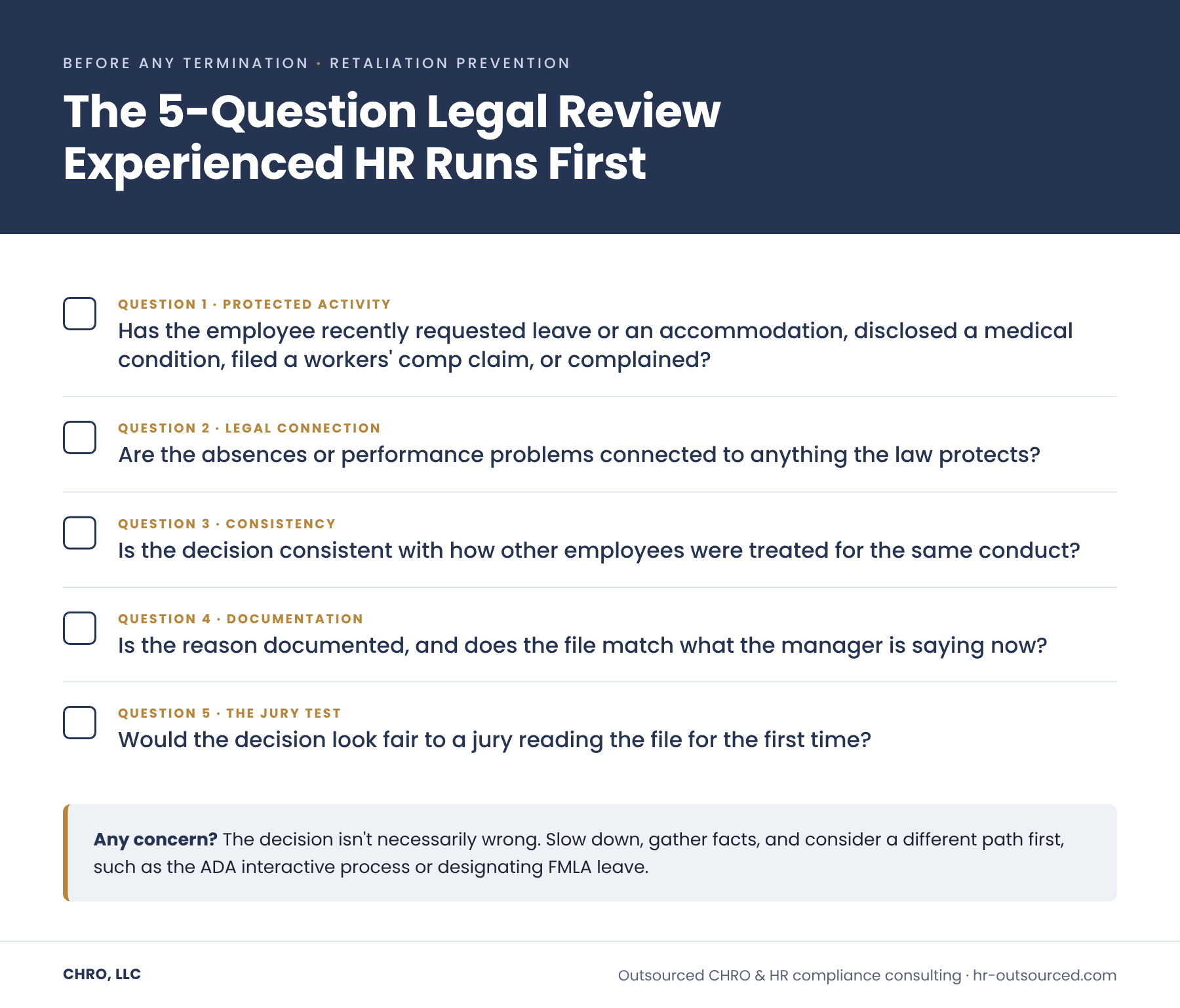
Before any termination or serious discipline, experienced HR runs a short legal review:
Has the employee recently requested leave or an accommodation, disclosed a medical condition, filed a workers' compensation claim, or made a complaint?
Are the absences or performance problems connected to anything the law protects?
Is the decision consistent with how the company has treated other employees for the same conduct?
Is the reason documented, and does the documentation match what the manager is saying now?
Would the decision look fair to a jury reading the file for the first time?
If any answer raises concern, the decision isn't necessarily wrong. It means the employer needs to slow down, gather facts, and possibly take a different path, such as engaging in the interactive process or designating FMLA leave first. Our guide on how to legally fire someone for poor performance walks through the process.
11. Weak HR Infrastructure: Policies, Job Descriptions, and Processes That Collapse Under Pressure
Many employers don't realize how much liability is baked into their HR infrastructure itself:
vague policies that don't match actual practices
highly subjective performance evaluations that depend on manager personality rather than measurable criteria
inconsistent discipline that varies by department, manager, or mood
job descriptions that are outdated, inaccurate, or copied from the internet
generic template policies that don't match the employer's culture, goals, workforce, or regulatory environment
This is the foundation inexperienced HR personnel are asked to operate within: a structure that can't support compliance even under ideal conditions.
These documents carry more legal weight than most employers expect. Job descriptions help determine which duties are "essential functions" under the ADA and whether a position qualifies for an FLSA exemption. Handbook policies become the yardstick a jury uses to decide whether discipline was fair. Performance criteria determine whether a termination looks objective or personal.
When these pieces are outdated or inconsistent, even good decisions become hard to defend. Building a sound HR infrastructure means accurate job descriptions tied to actual duties, a handbook tailored to your states and workforce, measurable performance standards, and a consistent discipline process that managers are trained to follow. Most growing companies carry hidden HR debt in exactly these areas.
12. The Cost of Underpaying HR: How Low Salaries Lead to High Legal Fees
Employers save a few thousand dollars in salary and then spend six figures defending preventable claims. Underpaying HR doesn't reduce risk; it guarantees it. The organization gets exactly what it paid for, and pays again and again when the consequences arrive.
The true cost of a preventable claim rarely shows up in one line item. It includes your own defense fees, the plaintiff's attorney's fees if you lose, back pay and damages, liquidated or punitive damages where the law allows, higher insurance premiums, and the hours executives spend in depositions instead of running the business. A single wage-and-hour class action can easily cost more than years of the salary difference between a junior HR generalist and an experienced HR leader, and these claims are not covered by most EPLI policies.
The problem often starts with how the role is scoped. Employers benchmark HR pay against generic salary bands, or promote a loyal operations manager into the HR seat without the legal training the role requires. The result is an HR function that processes paperwork well but can't spot legal risk. For a closer look at evaluating the HR leaders you already have, see our labor law attorney's guide to red flags in senior HR personnel.
For many small and mid-sized employers, the answer isn't a full-time executive salary. It's access to senior expertise when it matters, through an outsourced CHRO or HR consultant who works alongside your existing team.
When to Hire an HR Consultant or Outsource HR Leadership
If you recognized two or more of these signs, your HR function needs more labor law expertise than it has today. Common triggers for bringing in outside help include:
you're approaching 15 or 50 employees, the thresholds where the ADA, Title VII, and the FMLA begin to apply
you've hired remote employees in new states
you've received a DOL inquiry, an EEOC charge, or an attorney's demand letter
your HR function is a single generalist, or reports to Finance or Operations with no senior HR leader
you're implementing or reconfiguring an HRIS or timekeeping system
managers are making discipline and termination decisions without HR or legal review
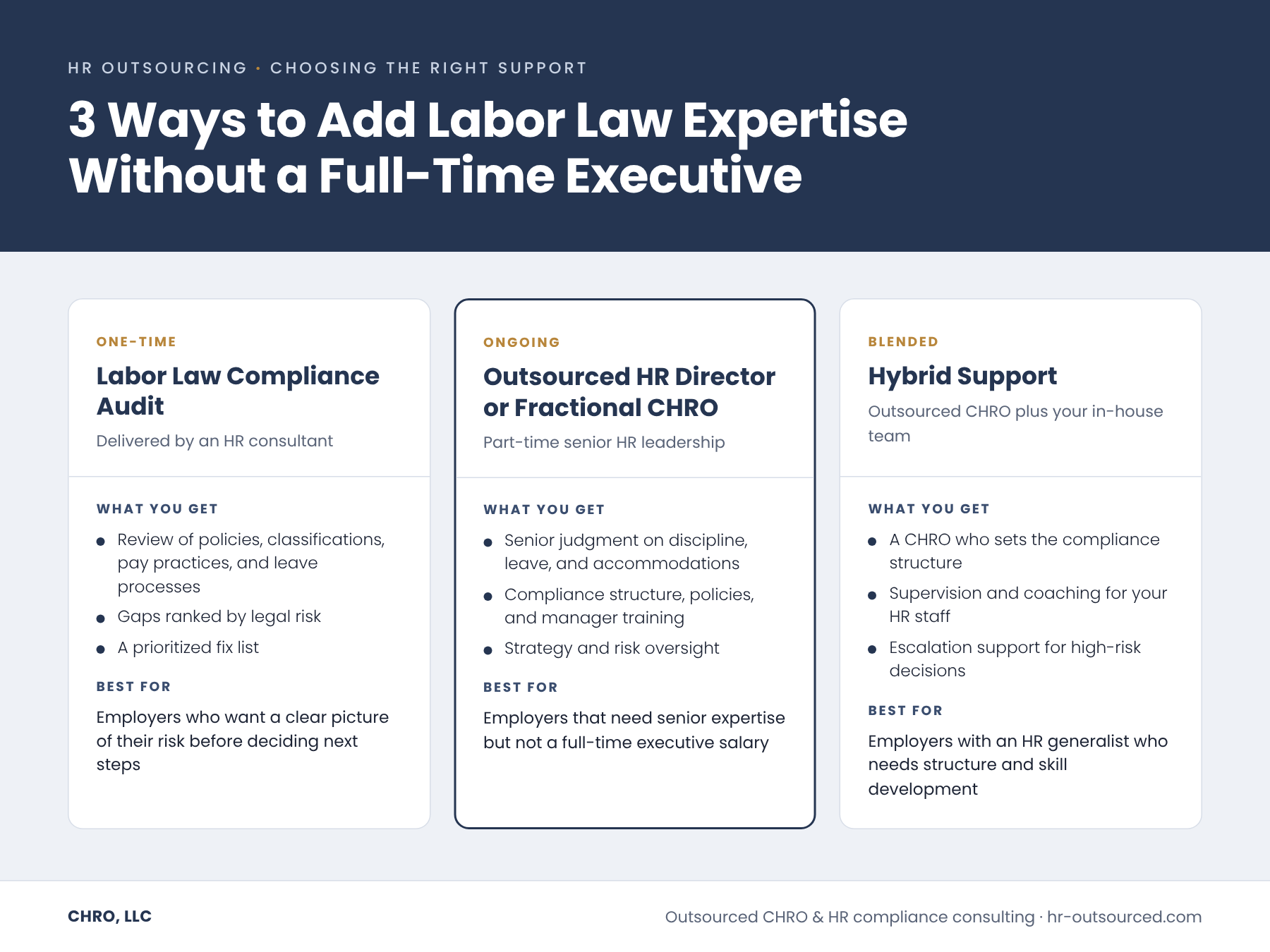
You don't necessarily need to replace your in-house team. Most employers choose one of three models:
HR consultant for a labor law compliance audit: a one-time review of your policies, classifications, pay practices, and leave processes, with a prioritized fix list.
Outsourced HR director or fractional CHRO: ongoing senior HR leadership on a part-time basis, for employers that need expertise but not a full-time executive.
Hybrid support: an outsourced CHRO who sets the compliance structure and supervises and coaches your in-house HR personnel to develop their skills.
Not sure which fits? Read Has Your Business Outgrown Its HR Function? Contact us to schedule a confidential discussion.
Frequently Asked Questions About HR Outsourcing and Labor Law Compliance
What are the signs that HR doesn't understand labor law?
Common signs include unpaid work time and overtime errors, missed ADA accommodation requests, poorly tracked FMLA leave, thin documentation, terminations that follow complaints, unlawful template policies, and harassment complaints that end with the victim being moved. In most cases, managers are making legal decisions without HR review.
What does an HR consultant do for labor law compliance?
An HR consultant reviews how your policies, pay practices, job classifications, leave processes, and manager decisions line up with federal and state employment law. The consultant identifies gaps, prioritizes them by risk, and helps you fix them before they turn into claims. See What Does an Outsourced HR Department Actually Do?
When should a small business outsource HR?
A small business should consider outsourcing HR when it approaches 15 or 50 employees, hires in new states, receives an agency charge or demand letter, or relies on a single generalist with no senior HR leader. Outsourcing is also worth considering before implementing a new HRIS or timekeeping system.
Is outsourcing HR cheaper than hiring an in-house HR manager?
For many small and mid-sized employers, yes. An outsourced HR director or fractional CHRO gives you senior-level expertise for a fraction of a full-time executive salary. It also costs far less than defending a preventable wage-and-hour, ADA, or retaliation claim. See Why Outsourced HR Is the Smartest Choice for Growing Businesses.
What's the difference between an outsourced HR director and a fractional CHRO?
The terms overlap. Both provide part-time senior HR leadership. A fractional CHRO usually works at the executive level on strategy, risk, and compliance architecture, while an outsourced HR director may focus more on day-to-day HR operations.
How do I know if my company is out of compliance with labor laws?
The most reliable way is an HR compliance audit. Warning signs include employees working unrecorded time, automatic break deductions, inconsistent discipline, outdated job descriptions, template policies, and managers handling medical or leave issues on their own. Start with our HR Compliance Audit: 10 Critical Areas Every Employer Should Evaluate.
Does EPLI insurance cover wage-and-hour claims?
Usually not. Most employment practices liability policies exclude FLSA and state wage-and-hour claims, or offer only a limited defense-cost sublimit. That makes these claims very costly, and prevention is the employer's main line of defense.
Get Experienced HR Leadership Before the Next Claim
Every failure on this list is preventable, and preventing it costs far less than defending it. CHRO, LLC provides outsourced CHRO and outsourced HR director services and HR compliance consulting for small and mid-sized employers, built on litigation-informed judgment rather than templates.
Schedule a confidential labor law compliance review to find your gaps before a plaintiff's attorney does.