
What is HR Outsourcing?
HR outsourcing is one of the most misunderstood terms in the HR space. Most executives assume it means payroll software, an HR call center, or a stack of policy templates. True HR outsourcing — the kind that actually protects companies and improves workforce performance — is something entirely different: a senior HR expert operating as your HR function, embedded in your leadership team, without the cost of a full-time internal hire.
What HR Outsourcing Actually Is — and What It Isn't
HR outsourcing is the strategic transfer of your company's HR functions — compliance administration, employee relations, workforce policy, and strategic leadership — to a senior-level outside expert who operates as part of your team. Not clerical support. Not a call center. Not a chatbot. A seasoned professional with CHRO-level judgment who knows your workforce, your managers, your compliance obligations, and the friction points your company is living with right now.
The confusion arises because the market uses the phrase "HR outsourcing" to describe three very different types of providers:
HR software platforms (BambooHR, Rippling, Gusto) — technology that automates payroll and recordkeeping. No human judgment. No legal guidance. Infrastructure, not expertise.
PEOs (Professional Employer Organizations) — a co-employment model designed primarily for benefits pooling. Useful for companies seeking lower benefits costs. Rarely includes CHRO-level leadership, individual ADA/FMLA case management, or hands-on employee relations work.
Boutique outsourced CHRO firms (this firm) — no software, no co-employment, no pooled benefits. Senior HR judgment applied directly to your workforce. Real-time. Hands-on. Labor law compliance aware.
Why Growing Companies Turn to HR Outsourcing
Companies don't pursue HR outsourcing because they want to outsource HR. They pursue it because the business has become harder to run — and the friction is coming from the people side. What begins as isolated incidents gradually becomes a pattern of operational drag that no one inside the company has the expertise or the bandwidth to fully diagnose.
The warning signs are recognizable:
Managers are improvising discipline with no consistent framework
Complaints are handled differently depending on which manager receives them
Turnover is rising for reasons that should have been preventable
Performance issues escalate because no one knows when or how to intervene
Policies and procedures written for 30 employees are being stretched over 150
Compliance obligations are multiplying across states and regulatory environments
No one internally is a labor law expert — and the company is absorbing risk without realizing it
These are not growing pains. They are structural gaps — and they compound as headcount grows.
The Hidden Risk of Accidental HR

Growing companies often rely on well-intentioned employees who were never trained for HR: the office manager who inherited HR duties, the operations coordinator who "deals with people stuff," the admin who processes paperwork without knowing what questions to ask. They are not failing. They are doing their best in a role that has outgrown their training.
The problem is structural, not personal: they don't know what must be documented, escalated, investigated, or handled consistently. They navigate ADA, FMLA, EEOC, wage-and-hour rules, and multi-state labor law without the foundation to interpret them correctly. Their decisions feel reasonable in the moment. When challenged — by a former employee, a regulatory agency, or opposing counsel — those decisions can be legally indefensible. The company bears the consequence, not the well-intentioned employee who made the call.
This is the accidental HR problem. It is one of the most common — and most expensive — vulnerabilities growing companies carry. It is also the one most likely to go undetected until something goes wrong.
Why HR Outsourcing Becomes Essential at 100 Employees
The 100-employee mark is a genuine legal and organizational inflection point. FMLA coverage kicks in at 50 employees. ADA administration grows significantly more complex as headcount increases. Multi-state compliance obligations multiply. And something organizational happens that most CEOs feel before they can name it.
Issues that were once isolated begin creating operational friction. Managers handle the same situations differently, which creates perceived inequity and erodes trust. Informal processes that used to work now create inconsistency that becomes a liability. Performance conversations that happened naturally now need structure to be defensible. And the CEO who once knew everyone personally is now three layers removed from the people decisions creating the most risk.
Above 100 employees, informal HR becomes a legal exposure. Above 200 or 300, it becomes untenable. Most companies at this stage don't need a full HR department. They need a CHRO.
What HR Functions Can Be Outsourced?
At CHRO, LLC, outsourced HR services cover the functions that carry the highest legal risk when handled incorrectly:
ADA administration — accommodation requests, interactive process guidance, medical certification coordination, documentation, and return-to-work planning. See more»
FMLA administration — leave tracking, eligibility determination, notice management, healthcare provider communication, and compliance documentation. See more»
Employee relations — complaint intake, workplace investigations, disciplinary documentation, performance management structure, and manager coaching. See more»
Termination risk management — documentation review, risk assessment, and termination letter drafting before any separation occurs. See more on our outsourced Employee Relations Service»
Strategic CHRO leadership — organizational structure guidance, workforce planning, manager development, and executive coaching. Our Outsourced CHRO leadership service includes:
Policy and handbook development — employment policies and HR documentation frameworks built for your workforce and your industry. See more on our Outsourced CHRO Service»
HR systems design — workflows, documentation standards, onboarding structure, and performance management architecture. See more on our Outsourced CHRO Service»
Executive coaching — structured confidential coaching for owners, CEOs, and senior leaders navigating complex people decisions, accountability challenges, and leadership development. See more on Executive Coaching»
HR compliance — ongoing monitoring and management of federal, state, and local employment law obligations, including wage-and-hour, multi-state requirements, and regulatory changes that affect your workforce. See more on HR Compliance»
Manager training — targeted training on escalation protocols, documentation requirements, retaliation avoidance, performance conversations, and how to handle high-risk situations correctly. See more on Manager Training»
HR staff support and development — working directly alongside your existing HR staff to build their capabilities, close knowledge gaps, and provide senior-level oversight and mentorship so your internal team grows stronger over time rather than being replaced. See more on our Outsourced CHRO Service»
Payroll processing and benefits administration are not included — what is included is judgment, compliance administration, and strategic HR leadership.
Why HR Templates Cannot Fix Your Workforce Problems — The Physician Analogy
Most companies think they know what HR support they need — a policy here, a handbook update there, a form for this situation. That assumption is the same as walking into a doctor's office and telling the physician what procedure to perform before they have examined you.
You don't tell a physician what treatment to prescribe. You describe the symptoms. The physician diagnoses the actual problem.
That is the difference between a template-driven HR vendor and a true outsourced CHRO.
Template-driven HR vendors wait for you to request something — a policy, a form, a process — and hand you a generic version of it. They are order-takers. They assume you have already correctly diagnosed the problem. But CEOs rarely have the time or the HR expertise to identify the root cause of workforce friction. They are reacting to symptoms.
A true outsourced CHRO operates completely differently. They do not wait for a request. They do not assume you have diagnosed the problem correctly. They examine your company the way a physician examines a patient:
What is actually causing the friction — and is it what leadership thinks it is?
Where is the breakdown in management judgment, and what is sustaining it?
What is driving turnover or conflict, and what does it signal about the culture?
What is exposing the company to legal risk — and does leadership know?
What patterns are managers repeating that are creating liability without anyone naming it?
What is happening culturally that no one is yet prepared to address?
Only after understanding the environment and the underlying causes does a true CHRO prescribe the right solution — sized for the company's actual workforce, industry, and risk profile.
A policy template cannot do that. A call center cannot do that. A senior HR leader embedded in your team can.
This is why companies that rely on template-driven HR continue experiencing the same problems year after year. They are treating symptoms, not causes.
The Cost Reality — Outsourced CHRO vs. Full-Time HR Hire
A full-time CHRO costs $180,000–$260,000 in base salary, before benefits, taxes, bonuses, and recruiting fees. A qualified HR Director runs $95,000–$140,000, but without the strategic range, legal-risk judgment, or C-suite perspective that complex workforce situations require. Most growing companies cannot justify those fixed costs, even when they clearly need the capability.
An outsourced CHRO delivers the same senior-level judgment, legal-risk awareness, manager coaching, and compliance oversight at a predictable monthly cost — typically 70–80% less than a full-time hire. The savings compound when you factor in avoided litigation, reduced turnover, and HR decisions made correctly the first time.
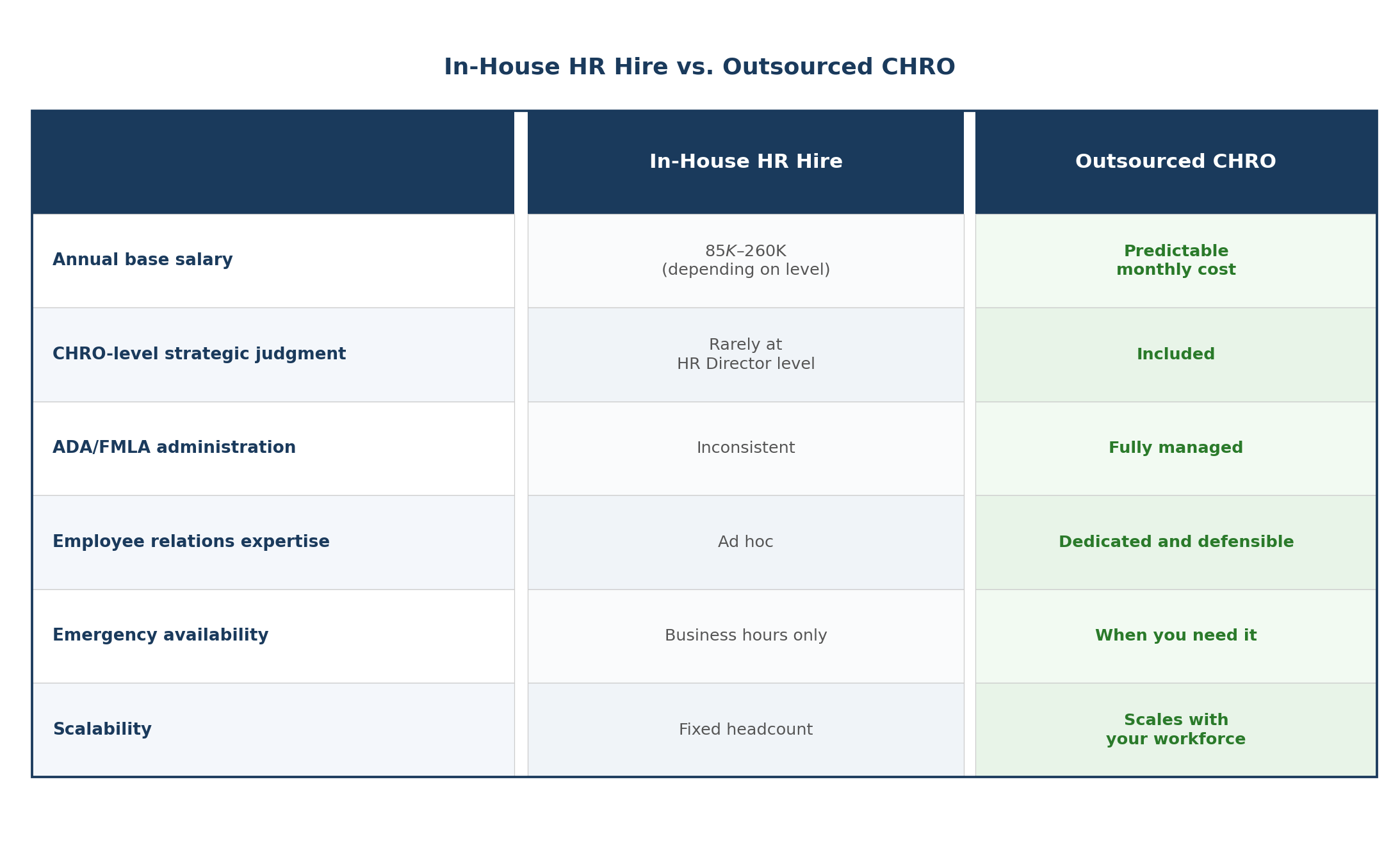
For service tier details and pricing, see our HR Outsourcing Pricing page →
Why HR Templates Cannot Fix Your Workforce Problems — The Physician Analogy
Most companies think they know what HR support they need — a policy here, a handbook update there, a form for this situation. That assumption is the same as walking into a doctor's office and telling the physician what procedure to perform before they have examined you.
You don't tell a physician what treatment to prescribe. You describe the symptoms. The physician diagnoses the actual problem.
That is the difference between a template-driven HR vendor and a true outsourced CHRO.
Template-driven HR vendors wait for you to request something — a policy, a form, a process — and hand you a generic version of it. They are order-takers. They assume you have already correctly diagnosed the problem. But CEOs rarely have the time or the HR expertise to identify the root cause of workforce friction. They are reacting to symptoms.
A true outsourced CHRO operates completely differently. They do not wait for a request. They do not assume you have diagnosed the problem correctly. They examine your company the way a physician examines a patient:
What is actually causing the friction — and is it what leadership thinks it is?
Where is the breakdown in management judgment, and what is sustaining it?
What is driving turnover or conflict, and what does it signal about the culture?
What is exposing the company to legal risk — and does leadership know?
What patterns are managers repeating that are creating liability without anyone naming it?
What is happening culturally that no one is yet prepared to address?
Only after understanding the environment and the underlying causes does a true CHRO prescribe the right solution — sized for the company's actual workforce, industry, and risk profile.
A policy template cannot do that. A call center cannot do that. A senior HR leader embedded in your team can.
This is why companies that rely on template-driven HR continue experiencing the same problems year after year. They are treating symptoms, not causes.

What Changes When You Bring In an Outsourced CHRO
When a true outsourced CHRO steps in, the impact is visible — not because problems disappear overnight, but because someone with the judgment to address them correctly is now in the room.
Managers stop improvising and make decisions within a consistent, defensible framework
Performance conversations happen earlier, are documented correctly, and are tied to outcomes — not personality or proximity
Documentation becomes defensible — terminations, disciplinary actions, and investigations are built on records that hold up when challenged
Employee relations issues surface and are resolved early — before they become separations, claims, or EEOC charges
ADA and FMLA cases are managed correctly from the first notice — no missed deadlines, no gaps, no improperly closed files
Leadership has a senior HR advisor in the room for high-stakes decisions — not a generalist reading from a checklist
This is HR as a strategic safeguard — not a back-office function.
Ready for a Real HR Diagnosis?
Your workforce problems, compliance exposure, and leadership gaps will not resolve themselves — and they will not be solved by a policy template. If your company has outgrown informal HR, the next step is a direct conversation with a senior HR professional who will examine your actual situation. No sales pitch. Just an honest assessment. Complete our Workforce Diagnostic to schedule a confidential consultation.
Frequently Asked Questions About HR Outsourcing
What is HR outsourcing? HR outsourcing is the practice of delegating your company's human resources functions to an external senior-level HR expert who operates as your HR function — without building a full internal department. It involves human judgment, employment law expertise, and strategic thinking, not software automation or call-center support.
What is an outsourced CHRO? An outsourced CHRO is a Chief Human Resources Officer who leads your HR function on a fractional or fully outsourced basis — bringing C-suite judgment, legal-risk awareness, and senior HR leadership without the cost of a full-time executive hire. They diagnose workforce problems, design HR systems, develop managers, and provide the strategic HR leadership growing companies need but often cannot afford internally.
What HR functions can be outsourced? The most valuable functions to outsource are those with the highest legal risk when mishandled: ADA and FMLA administration, employee relations (investigations, discipline, performance management), termination risk management, policy development, and strategic HR leadership. Payroll and benefits are typically handled separately.
How is HR outsourcing different from HR software? HR software automates workflows — payroll, recordkeeping, onboarding checklists. It is infrastructure. It provides no human judgment, no employment law guidance, and no real HR decision-making. When a manager asks "Can I fire this person?" or "How do I handle this accommodation request?", software cannot answer. A senior HR professional can.
What is the difference between fractional HR and outsourced HR? Fractional HR typically describes a part-time, hours-based engagement — the professional is available for consultation within a set time allocation. Outsourced HR describes a fuller transfer of operational responsibility — the provider runs the function, not just advises on it. At this firm, outsourced HR means we do the work, not just respond to questions.
What is the accidental HR problem? It occurs when HR responsibilities are handled by someone never trained for the role — an office manager, operations coordinator, or admin who inherited HR duties. They navigate ADA, FMLA, EEOC, and multi-state labor law without the expertise to do so correctly. Their decisions feel reasonable — and can be legally indefensible. The company bears the legal consequence.
How do I know if my company needs HR outsourcing? Key signals: managers are making improvised HR decisions that create legal exposure; compliance obligations (ADA, FMLA, EEOC) are being handled inconsistently; your documentation would not survive a legal challenge; turnover and complaints are rising for reasons you cannot diagnose internally; and no one on your team can tell you with confidence whether your HR decisions are defensible.
What should I look for in an HR outsourcing partner? Find a provider who diagnoses before prescribing — who learns your company, your workforce, and your risk profile before offering solutions. Look for CHRO-level experience, deep employment law expertise, direct access to a named senior professional (not a call-center queue), and demonstrated capability in ADA/FMLA administration and workplace investigations.
Ready for a Real HR Diagnosis?
Your workforce problems, compliance exposure, and leadership gaps will not resolve themselves — and they will not be solved by a policy template. If your company has outgrown informal HR, the next step is a direct conversation with a senior HR professional who will examine your actual situation. No sales pitch. Just an honest assessment. Contact us to book a confidential consultation.
Articles on Human Resources Best Practices


Rude isn’t always illegal, and silence isn’t consent. Learn the federal hostile work environment test, why the word “unwelcome” derails investigations, and which states have set a lower bar for harassment claims.